
What is a vacuum valve? Inventory of 7 semiconductor processes that use vacuum valve components
Contents
- 1. Main uses of vacuum valves in semiconductor applications
- 1.1 Application 1: Gas control and regulation
- 1.2 Purpose 2: Maintaining a vacuum environment
- 1.3 Purpose 3: Prevent cross contamination
- 1.4 Application 4: Gas sealing and exhaust
- 1.5 Application 5: Improving process accuracy
- 2. What are the vacuum valve components for semiconductor applications?
- 2.1 Vacuum Gate Valve
- 2.2 Vacuum transfer valve
- 2.3 Vacuum right angle valve
- 3. Which semiconductor processes require vacuum valves?
- 3.1 Chemical Vapor Deposition (CVD)
- 3.2 Physical Vapor Deposition (PVD)
- 3.3 Plasma Etching
- 3.4 Atomic Layer Deposition (ALD)
- 3.5 Ion Implantation(Ion Implantation)
- 3.6 Cleaning (such as wet cleaning, vacuum cleaning)
- 3.7 Coating
- 4. Anlai Technology | Vacuum valve manufacturer recommendation
The increase in technological demands has driven the semiconductor market and increased the reliance on vacuum valve components. This article introduces the importance of vacuum valve components to semiconductors, the introduction of vacuum valve components and the process applications of semiconductors.
Main uses of vacuum valves in semiconductor applications
The application of vacuum valve components in semiconductor manufacturing processes is very critical, mainly because semiconductor manufacturing processes often require a high vacuum environment to ensure process accuracy and product quality. Vacuum valves are core equipment for controlling gas flow, maintaining vacuum state and regulating gas pressure. The following are the main uses of vacuum valves:
Application 1: Gas control and regulation
In the semiconductor manufacturing process, precise control of gases is required during chemical vapor deposition (CVD), physical vapor deposition (PVD), sputtering and other processes. Vacuum valves can be used to control the entry and flow of different gases to ensure that the gas concentration, pressure and flow rate can reach the required conditions in each process step.
Purpose 2: Maintaining a vacuum environment
Many semiconductor process steps, such as coating and dry etching, need to be performed in a high vacuum environment. Vacuum valves are used to maintain the vacuum in the working environment, prevent external gases from entering, and ensure that the internal vacuum is not disturbed during the process due to valve leakage or improper operation.
Use 3: Prevent cross contamination
During semiconductor manufacturing processes, different gases, chemicals or reactants may cross-contaminate each other. Vacuum valves can accurately switch, exhaust and isolate reactive gases, prevent the mixing of different gases or substances, and thus ensure purity and stability at each process stage.
Application 4: Gas sealing and discharge
In some semiconductor manufacturing processes, when the process is completed or needs to be interrupted, vacuum valves can quickly close the system and control the emission of exhaust gas. For example, when certain gases or chemicals need to be discharged, vacuum valves can help effectively control the exhaust system and avoid the leakage of harmful gases.
Application 5: Improve process accuracy
In the semiconductor manufacturing process, every slight environmental change may affect the quality of the final product. Precise control of vacuum valves ensures the stability of gas, pressure and flow, thereby improving process repeatability.
What are the vacuum valve components for semiconductor applications?
In the semiconductor manufacturing process, the vacuum environment is very important, and vacuum valves are key components to ensure the stability and control of the vacuum environment. These valves are used to precisely control gas flow, pressure and maintain vacuum level in the chamber:
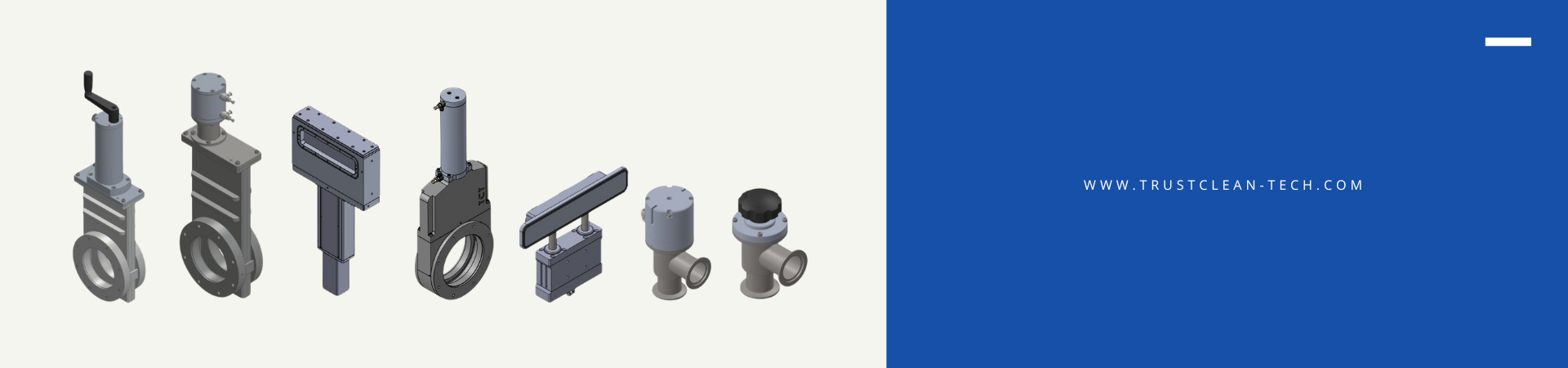
Vacuum Gate Valve
A vacuum gate valve is a valve that controls airflow through a gate. Its main function is to block different vacuum environments. It is mostly used in high vacuum and ultra-high vacuum environments. Vacuum gate valves are used in coating, chemical vapor deposition, and physical vapor deposition.
Vacuum transfer valve
A vacuum transfer valve is an indispensable device for the process of transferring wafer materials in a vacuum environment. It is usually used in a vacuum-to-vacuum environment to allow wafers to be freely transferred between different process equipment while maintaining a vacuum state during the transfer process.
Vacuum right angle valve
Vacuum right-angle valves are often used in limited space environments, so there are multiple designs for customers to choose from: such as right-angle, straight-line, and Z-type angle valves. The various appearances of angle valves allow customers to choose more efficient use of space. Pneumatic control of the valve plate is generally used, and there are also special electric types.
These vacuum valves ensure a stable vacuum environment, control airflow and improve production efficiency, which is particularly important in precision processes such as semiconductor manufacturing, vacuum coating, and physical vapor deposition (PVD).
Which semiconductor processes require vacuum valves?
Semiconductor manufacturing processes cannot be separated from the vacuum environment. In particular, vacuum valves play an important role in the following 7 processes.:
Chemical Vapor Deposition (CVD)
Chemical vapor deposition (CVD) is a process in which gaseous raw materials are introduced into a reaction chamber to deposit thin films through chemical reactions. It is widely used in semiconductor thin film deposition (such as silicon oxide layers, silicon nitride layers, etc.).
Physical Vapor Deposition (PVD)
Physical vapor deposition (PVD) converts solid materials into gas through evaporation, sputtering and other methods, and then deposits them onto the substrate. It is used for the deposition of metal layers and thin films.
Plasma Etching(Plasma Etching)
Plasma etching is a dry etching method and is currently the most commonly used etching method. It is often used for patterning and etching thin film layers. It can precisely process circuit patterns and requires extremely precise vacuum valve components.
Atomic Layer Deposition (ALD)
Atomic layer deposition (ALD) is a deposition method that can precisely control the thickness of thin films and is mainly used for the deposition of ultra-thin materials. Atomic layer deposition has extremely high requirements on gas flow and pressure, and requires vacuum valves such as vacuum gate valves and vacuum right-angle valves.
Ion Implantation
Ion implantation is used to implant specific ions into semiconductor wafers to change the electrical properties. Ion implantation is usually performed in a vacuum environment to ensure that the ions are accurately implanted into the wafer.
Cleaning (e.g. wet cleaning, vacuum cleaning)
During the semiconductor manufacturing process, cleaning is used to remove surface contaminants and residual chemicals. The cleaning process must be carried out in a vacuum environment, especially some wet cleaning steps followed by dry cleaning.
Coating
Coating is used to deposit thin films on the surface of wafers to achieve the desired electrical or mechanical properties. According to data from the Industrial Technology Research Institute, wafer surface coating is a prerequisite for subsequent lithography and etching processes. Depending on different needs such as luminescence, conductivity or protection, the material and composition of the film are different.
The coating process needs to be carried out in a vacuum environment to ensure the quality of the film and the final product yield. The required vacuum valves include vacuum gate valves, vacuum transfer valves, vacuum right-angle valves, etc.
Anlai Technology | Vacuum valve manufacturers recommended
Anlai Technology was established in 2019. It mainly produces independently developed high-precision precision processed products. All products have undergone ultra-high cleanliness electrolytic polishing surface treatment, combined with high welding capabilities and complete after-sales service. The product reliability can stand the test. If you have any questions about any semiconductor vacuum valve components, pleaseContact Us!
Further reading:
What are vacuum fittings? Professional customized vacuum piping service
What types of vacuum valves are there? Four key points for valve selection
What is an angle valve? What are the application areas of angle valves?